

Trinity County received a grant to develop a process to provide electricity to Post Mountain. Flowra was selected as the contractor to analyze at least three methods for obtaining electricity: (A) Extension of TPUD lines from Hayfork to Post Mountain, (B) Connection of PG&E lines passing through Post Mountain to a local distribution system, (C) Creation of a solar microgrid.
The final report is here (Click me)
Post Mountain is a subdivision consisting of more than 1,000 parcels and a population of 3,000. Despite being bisected by PG&E high-voltage transmission lines, there is no electrical connection between the community and the power grid. The nearest grid-connected communities are Peanut and Forest Glen, about 8 miles away and Wildwood, about 13 miles away.
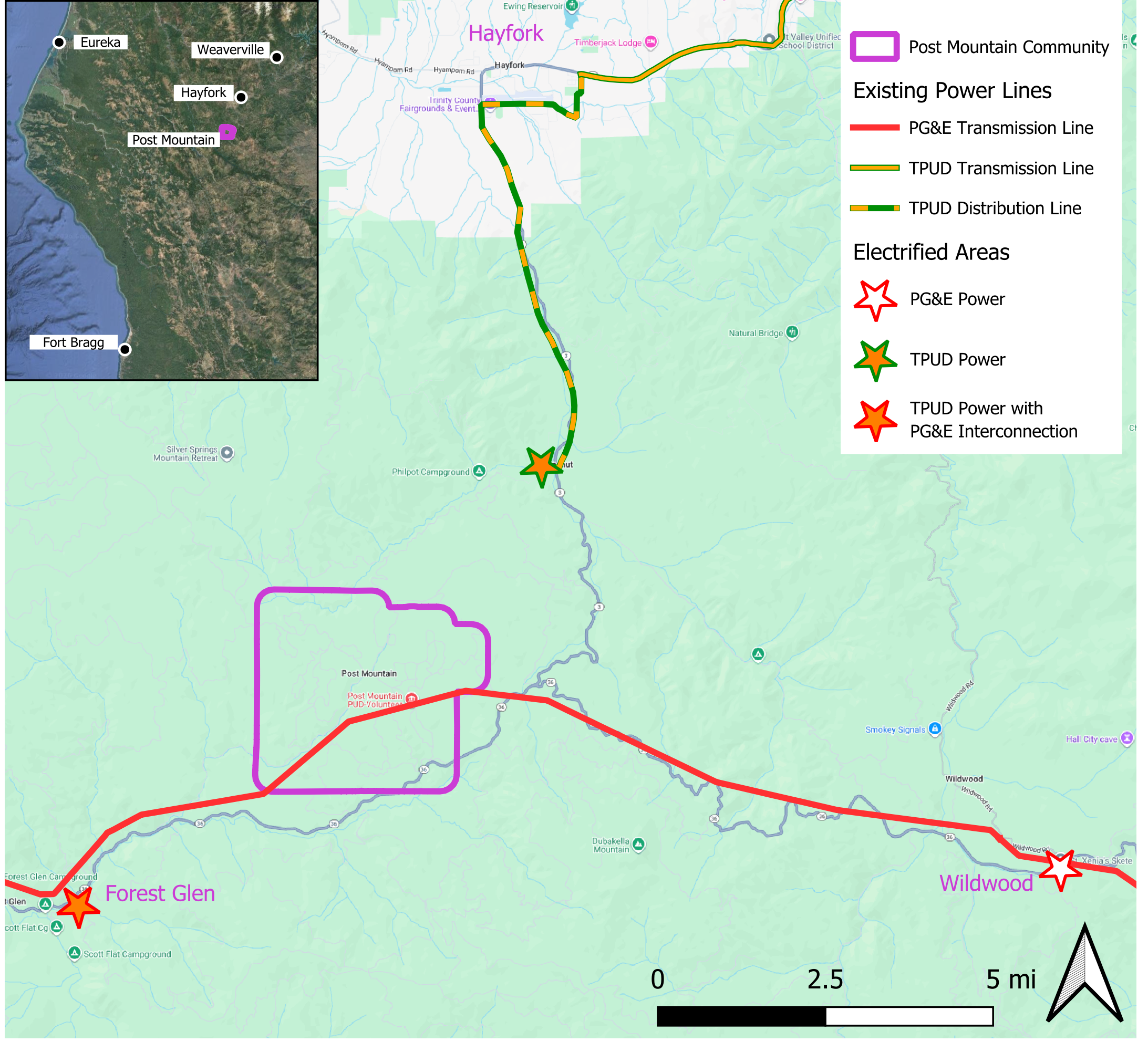
Map of Post Mountain. Inset shows relationship to larger communities. Main map shows relation to electrified areas of Hayfork, Forest Glen and Wildwood.
Residents rely on generators, solar systems, and batteries to obtain electricity for their homes. This results in limited power, low reliability, and negative health and environmental impacts.
The study analyzes three primary electrification strategies—connection to Trinity Public Utility District (TPUD), connection via Pacific Gas & Electric (PG&E), and development of a local solar microgrid—across five specific options. Each option is assessed based on capital cost, cost of monthly electric bill, greenhouse gas (GHG) reduction potential, environmental and cultural impacts, permitting requirements, and overall feasibility.
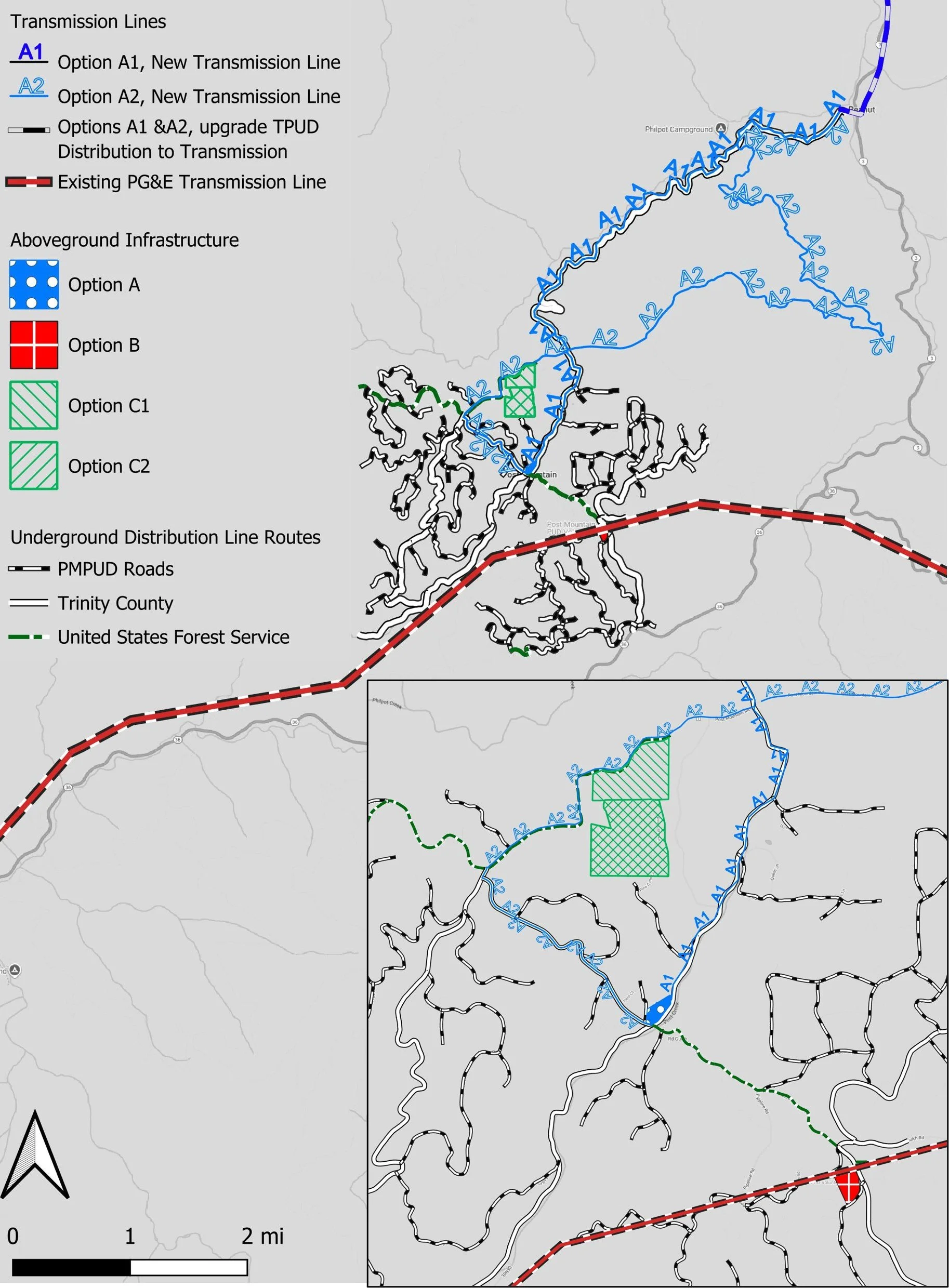
Map showing options for electrification of Post Mountain as analyzed in the study.
Key findings
All electrification options would significantly improve public health by eliminating emissions from gasoline and propane generators and enabling cleaner indoor energy use. Each option also reduces greenhouse gas emissions, with the highest reductions associated with TPUD connection options (Options A1 & A2).
Estimated capital costs range from approximately $12.9 million to $49.2 million.
TPUD options (A1, A2) are the least expensive.
PG&E interconnection (B2) is the most costly due to the cost of constructing a switching station to PG&E standards.
Microgrid options (C1, C2) fall in the mid-range but include operational and scalability challenges.
Monthly electricity costs are relatively similar across options (~$104–$114); however, microgrid options (C1, C2) would require that most of the monthly bill be made up of a connection fee that would not decrease with decreased use.
Environmental Tradeoffs:
TPUD options (A1, A2): Highest risk of habitat fragmentation due to new transmission lines, especially near sensitive riparian areas.
Microgrid options (C1, C2): Require significant land clearing (20–40 acres), causing concentrated ecological disturbance.
PG&E interconnection (B2): Lowest environmental impact due to minimal new infrastructure.
Feasibility and Risk:
Option B2 (PG&E interconnection) is considered the most viable despite higher cost, due to fewer environmental constraints and a clearer implementation pathway.
TPUD options face substantial permitting hurdles (NEPA/CEQA) and environmental risks.
Microgrid options present administrative and scalability challenges.
Funding Challenges:
While clean energy funding programs exist, Post Mountain is currently ineligible
However, engagement with state agencies and legislators indicates strong potential for future policy changes to unlock funding opportunities.
RecommendationsWe recommend pursuing Option B2 (PG&E interconnection with TPUD distribution) as the preferred strategy. Although it has the highest upfront cost and requires coordination with PG&E, it offers the best balance of feasibility, environmental protection, and long-term success.
Next stepsAssuming that Option B2 is selected, we recommend continuing the process of Post Mountain electrification with the following steps.
Refine design and cost estimates for the PG&E interconnection.
Conduct required technical studies (System Impact and Facility Studies).
Engage state legislators to modify funding eligibility criteria.
Continue community engagement to ensure local support and participation.
Dedicate or obtain funding to continue working on the project.